

Device calibrations and connectivity
Fetch live coupling maps and calibration data for QPUs on qBraid, plot connectivity graphs, and use the data to place circuits on the best-calibrated qubits before submitting.
Requires the latest qbraid pre-release: pip install --upgrade --pre qbraid. Calibration data is refreshed from each hardware provider roughly
hourly.
Superconducting QPUs are not uniform: qubits differ in readout fidelity, and two-qubit gates only exist between physically coupled pairs, each with its own error rate. The QbraidProvider exposes both facts programmatically, so you can inspect a device before you submit to it, and place your circuit on the qubits where it will perform best.
Do you need this?
No. Calibration-aware qubit selection is an optimization, not a prerequisite —
you can submit jobs without ever calling get_calibrations(). When you submit a
circuit, the provider’s compiler already chooses a physical layout for you,
using these same calibration tables to avoid the worst qubits.
Reach for this page when you hit a question the default path does not answer:
- “Why did my results change since last week?” Devices drift and are recalibrated continuously, so comparing snapshots often explains it.
- “Which device should I run on?” Qubit count alone says little; error rates and coherence times say more.
- “Can I beat the default layout?” For deep circuits, pinning a high-fidelity qubit chain can outperform automatic placement.
- Noise characterization and benchmarking, where the calibration data is itself the object of study.
Fetching calibration data
Every QbraidDevice has two entry points:
from qbraid.runtime import QbraidProvider

provider = QbraidProvider()
device = provider.get_device("rigetti:rigetti:qpu:cepheus-1-108q")

device.coupling_map
# ((0, 1), (0, 9), (1, 2), (1, 10), (2, 3), ...)  193 physical qubit pairs

calibration = device.get_calibrations()
calibration.last_calibrated
# '2026-07-21T20:05:45+00:00'
coupling_map is the device’s physical connectivity: sorted, deduplicated
(source, target) qubit pairs, derived from the calibrated two-qubit gate
edges. It is cached on the device instance, since hardware topology does not
change between calibrations.
get_calibrations() returns the full live snapshot and always fetches fresh
data. The two most useful fields:
# Per-edge two-qubit gate error, keyed by gate name
calibration.edges["gateError"]["cz"][0]
# EdgeEntry(source=0, target=1, value=0.0246)

# Per-qubit metrics
calibration.qubits["0"]
# QubitCalibration(readout_error=0.04, gate_error={'rb': 0.0019}, ...)
Both return None for devices without published calibration data, such as
simulators.
Devices with calibration data
| Physical device | Qubits | Edges | Example device IDs |
|---|---|---|---|
| Rigetti Cepheus-1-108Q | 107 | 193 | rigetti:rigetti:qpu:cepheus-1-108q, aws:rigetti:qpu:cepheus-1-108q |
| IQM Garnet | 20 | 30 | aws:iqm:qpu:garnet |
| IQM Emerald | 54 | 85 | aws:iqm:qpu:emerald |
| AQT Ibex-Q1 | 12 | 0 | aws:aqt:qpu:ibex-q1 |
All device IDs that map to the same physical hardware share one calibration
snapshot, so rigetti:rigetti:qpu:cepheus-1-108q and
aws:rigetti:qpu:cepheus-1-108q return identical data.
A device can have calibration data with an empty edge list. AQT’s Ibex-Q1 is a
trapped-ion system with all-to-all connectivity, so there are no discrete
coupling edges to report: coupling_map returns an empty tuple, not None.
For IonQ trapped-ion devices, see device.profile.characterization instead.
You can also query the underlying REST endpoint directly, which works for any device ID including those not available for direct submission:
curl -H "X-API-Key: $QBRAID_API_KEY" \
  https://api.qbraid.com/api/v1/devices/rigetti:rigetti:qpu:cepheus-1-108q/calibrations
Plotting the connectivity graph
The qbraid.visualization module renders the graph in one call, colored by
live calibration data. Edges are colored by two-qubit gate error and nodes by
readout error, on a single-hue scale where darker is better, matching the
topology view in qBraid Lab:
from qbraid.visualization import plot_connectivity_graph

plot_connectivity_graph(device)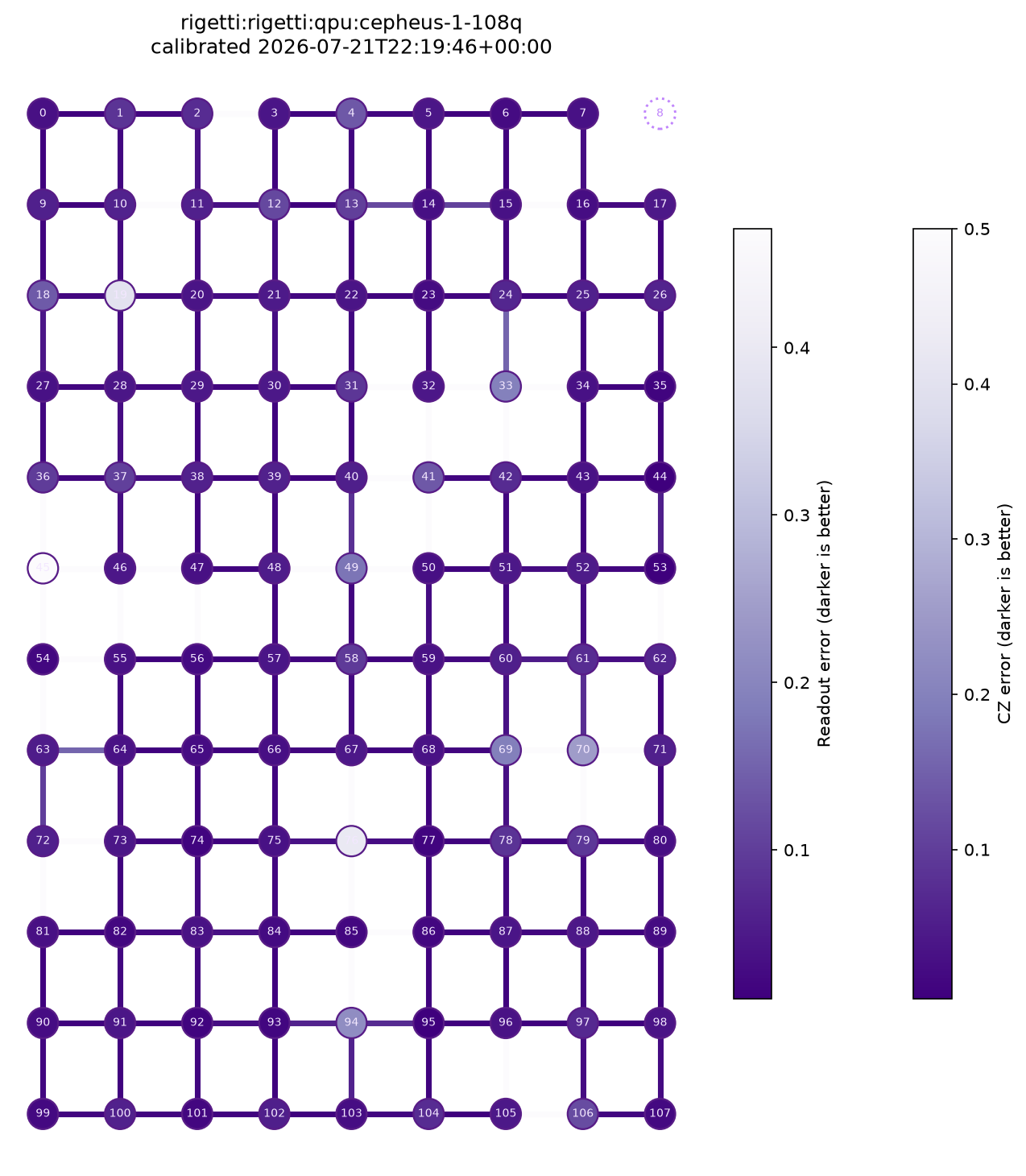
The dotted outline is a qubit in the lattice footprint with no working couplings. Light qubits and edges are the ones to avoid.
The layout comes from the device document’s topology config, so square
lattices (Rigetti) and clipped lattices (IQM) both render their true physical
geometry; devices without a lattice config fall back to a force-directed
layout. To build a custom plot, the lattice_positions helper maps qubit ids
to grid coordinates from the same config:
from qbraid.visualization import lattice_positions

topology = device.client.get_device(device.id).topology
# {'type': 'square-lattice', 'rows': 12, 'cols': 9}

positions = lattice_positions(topology, range(108))
# {0: (0, 0), 1: (1, 0), ..., 107: (8, -11)}
The same call works unchanged on any device with calibration data. IQM’s Garnet renders its clipped diamond lattice:
garnet = provider.get_device("aws:iqm:qpu:garnet")
plot_connectivity_graph(garnet)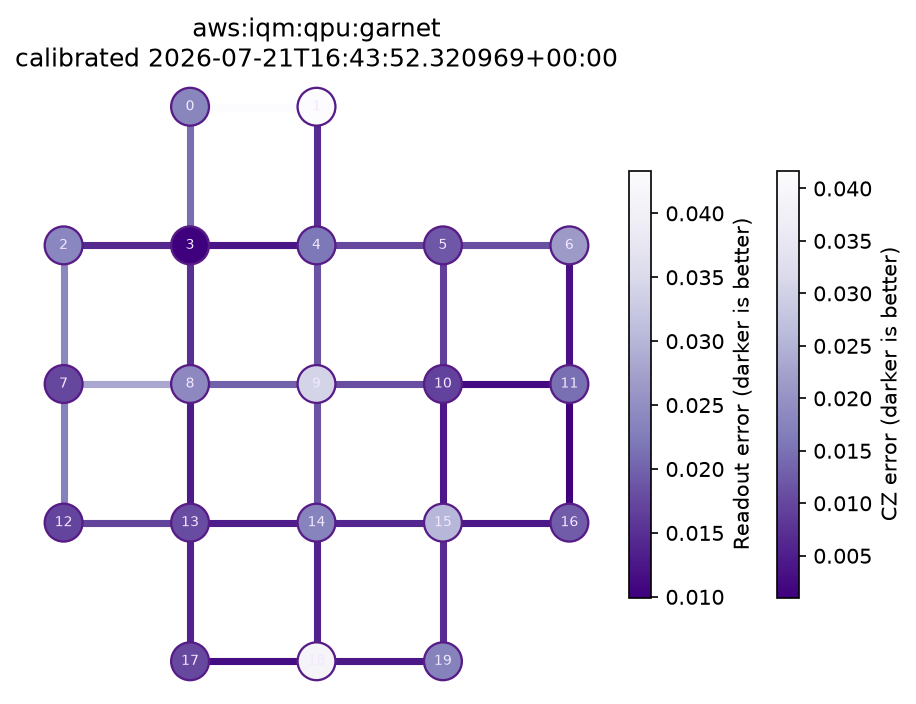
Choosing the best qubits
With the calibration data in hand, qubit selection becomes a graph problem. Build a weighted graph from the coupling map, then the single best-calibrated pair is one line:
import networkx as nx

calibration = device.get_calibrations()
edge_error = {
    (e.source, e.target): e.value
    for e in calibration.edges["gateError"]["cz"]
}

graph = nx.Graph()
for q0, q1 in device.coupling_map:
    graph.add_edge(q0, q1, error=edge_error.get((q0, q1), edge_error.get((q1, q0))))
best_edge = min(edge_error, key=edge_error.get)
# (88, 89), CZ error 0.0037 -- 2.3x better than the device medianThe lowest CZ error is not always the best place to run. Readout error varies by an order of magnitude across the lattice, and on some snapshots the best-CZ edge sits on a qubit with weak readout. For two-qubit circuits, score edges on the product of CZ, readout, and single-qubit fidelities; see Scoring edges for a worked example where the two rankings disagree on hardware.
For a linear circuit on n qubits, search for the connected chain that
minimizes the summed two-qubit error:
def best_chain(graph, length):
    """Find the simple path of `length` qubits minimizing summed edge error."""
    best = (float("inf"), None)

    def extend(path, total):
        nonlocal best
        if total >= best[0]:
            return
        if len(path) == length:
            best = (total, list(path))
            return
        for nbr in graph.neighbors(path[-1]):
            if nbr not in path:
                path.append(nbr)
                extend(path, total + graph.edges[path[-2], nbr]["error"])
                path.pop()

    for start in graph.nodes:
        extend([start], 0.0)
    return best


total, chain = best_chain(graph, 5)
# chain = [88, 89, 98, 97, 96], summed CZ error 0.0214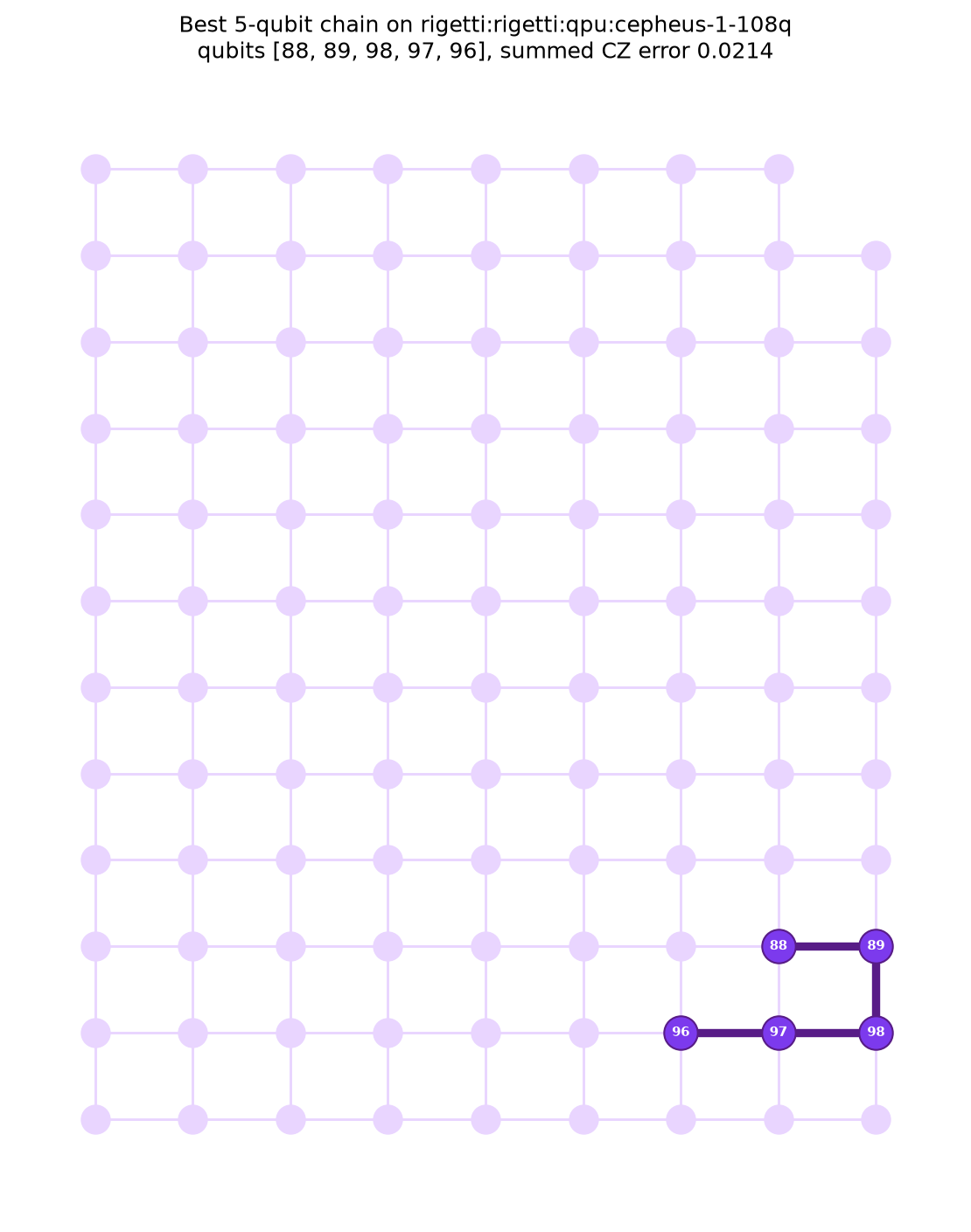
Calibrations shift with every refresh, so re-run the selection shortly before you submit. The best chain this hour is not always the best chain tonight.
Running on the qubits you chose
Rigetti direct: hand-placed native gates
On the Rigetti direct path, programs that bypass quilc must already use native gates on physical qubits, which is exactly what the coupling map enables. A Bell pair on the best-calibrated edge:
import pyquil

q0, q1 = best_edge  # (88, 89)

program = pyquil.Program(f"""
DECLARE ro BIT[2]
RX(pi/2) {q0}
RX(pi/2) {q1}
CZ {q0} {q1}
RX(-pi/2) {q1}
MEASURE {q0} ro[0]
MEASURE {q1} ro[1]
""")

job = device.run(program, shots=100)
job.wait_for_final_state()
job.result().data.get_counts()
# {'00': 44, '11': 44, '01': 7, '10': 5}  -- run on Cepheus-1-108Q, 2026-07-21
The correlated outcomes (00 and 11) came back at 88 percent on hardware,
consistent with the roughly 0.4 percent CZ error and few-percent readout error
of the chosen pair.
This program contains no timing instruction, so it takes the compiled
path. The placement survives because its qubits already fit the topology,
which makes quilc default to identity (NAIVE) rewiring; quilc is not
obligated to keep it in general. To make placement a guarantee rather than a
default, add a clock-aligned delay to take the direct path, or pin the
compiled path with PRAGMA INITIAL_REWIRING "NAIVE". See Pinning the
circuit.
Qiskit: constrain transpilation to the real topology
If you would rather let a transpiler do the routing, feed the coupling map to Qiskit and pin your circuit to the chain you selected. This works for any gate-model device on qBraid:
from qiskit import QuantumCircuit, transpile
from qiskit.transpiler import CouplingMap

ghz = QuantumCircuit(5, 5)
ghz.h(0)
for i in range(4):
    ghz.cx(i, i + 1)
ghz.measure(range(5), range(5))

coupling = CouplingMap(
    [list(edge) for edge in garnet.coupling_map]
    + [[b, a] for a, b in garnet.coupling_map]
)
total, chain = best_chain(garnet_graph, 5)  # [6, 11, 16, 15, 10] on Garnet

transpiled = transpile(
    ghz,
    coupling_map=coupling,
    initial_layout=chain,
    basis_gates=["r", "cz"],
    optimization_level=3,
)

job = garnet.run(transpiled, shots=1000)
Every two-qubit gate in the transpiled circuit now acts on a physically coupled, well-calibrated pair, and no SWAP overhead is silently inserted for qubits you did not choose.
Transpile against the coupling map of the exact device ID you will submit to. Vendor-routed and direct device IDs share hardware and calibrations, but a circuit laid out for one device will not fit another.
Related links
- QbraidProvider: setup and credentials
- Rigetti Cepheus-1-108Q: native gates, Quil-T timing, and the two compilation paths
- Job execution: single, batch, and group submission
- Visualization: histograms and other built-in plotting utilities
Thanks for your feedback.